
Search once gave websites a return ticket. Generative answers still name their sources, but they stop the reader from going back.
In the past, a website was willing to let Google's crawler in because readers followed behind it.
Google read the page and ranked its link in search results. The author gained visits and a chance to be remembered; Google kept the query, the attention, and the search advertising. This exchange was never equal, and the platform always controlled the ranking rules. But it at least came with a return ticket: a search usually ended on the original website.
Today, the crawler still comes in, but the reader is increasingly likely to stay on Google.
The Pew Research Center tracked the browsing behavior of 900 U.S. adults in March 2025. Across 68,879 Google searches, users clicked a traditional search result after seeing an AI summary in 8% of visits, compared with 15% when no AI summary appeared. Only 1% of visits to pages with an AI summary resulted in a click on one of the sources it cited. Pew click study
These figures are not enough to prove that generative search has already destroyed the entire internet. But one point is clear: the sources remain, while fewer clicks return to the original websites.
1. Old search was unequal, but it at least offered a return ticket
There is no reason to romanticize the “ten blue links.” Traditional search crawls webpages for free, decides who ranks first, and has long intercepted clicks through knowledge panels, featured snippets, and instant answers. Publishers changed headlines, stuffed pages with keywords, and shaped vast amounts of content for machine discovery in pursuit of rankings.
But old search still had a boundary: the platform handled discovery, while the full reading usually happened on the original website.
In 2014, Spain amended its copyright rules, and Google News subsequently shut down its local service. Economists treated the withdrawal as a natural experiment: overall news consumption among former Google News users fell by about 20%, while pageviews on publishers' websites fell by about 10%, with smaller publishers bearing more of the loss. The withdrawal showed that, while traditional aggregators profited from news, they also genuinely created discovery and referrals. NBER working paper
Generative search delivers a different product. A user asks a question; the platform retrieves several webpages, extracts facts, compares views, and produces an answer that can be used directly. The links have not disappeared, but they have receded from being the product itself to being citations beside the answer.
In this product, the original website is no longer the destination of search. It has become an upstream content supplier in the answer-production chain.
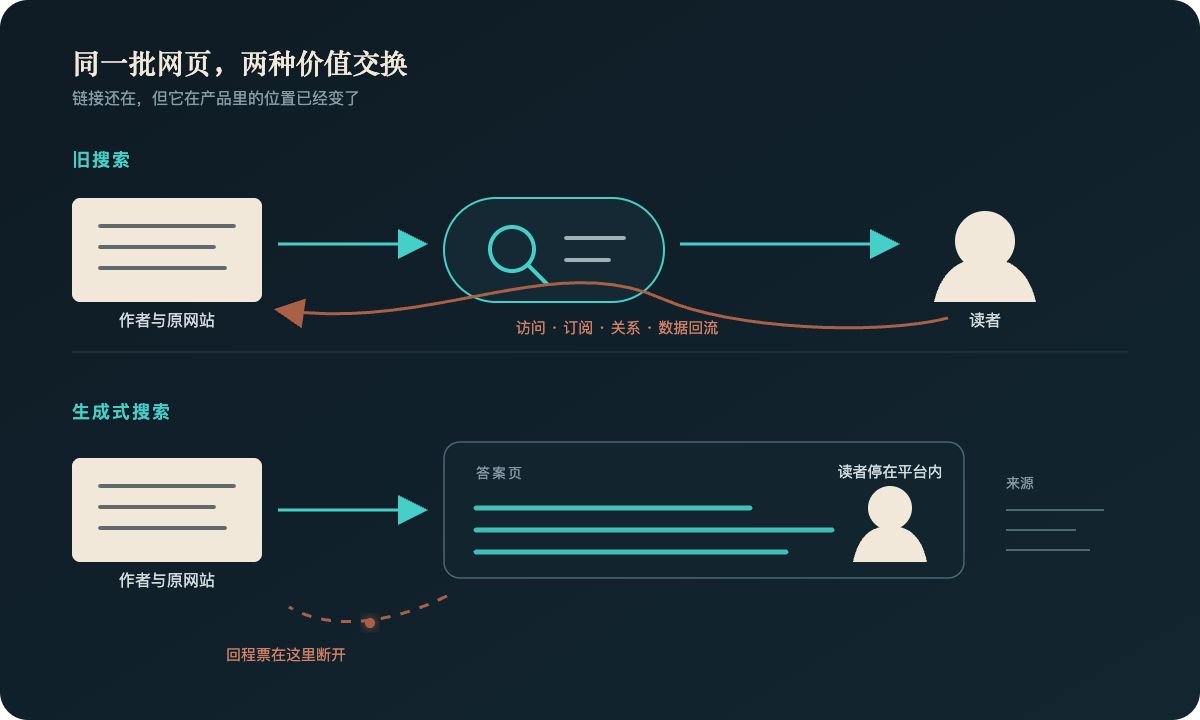
Figure | Old search still sent visits back; generative search keeps more consumption on the answer page.
2. A click carries more than a single visit
A click has never brought only one visit to the original website.
Once readers reach the original page, the author may gain an ad impression, an email subscriber, a paid member, or a comment. Readers may remember the site and return directly next time, bypassing search. The website can also see what users read and how long they stayed. That information, in turn, helps decide what to write next and which services are worth maintaining.
When users stay on the answer page, this value remains with the platform. The platform uses the knowledge in the webpage while also retaining the user's post-query attention, advertising opportunities, and behavioral data. The author may be left with nothing more than a source name folded away beside the answer.
Generative search therefore rewrites the relationship between platforms and websites. In the past, webpages were a complement to search: richer webpages made search more useful, and better search brought more readers to those pages. Now the platform can turn webpages into its own answers, allowing users to complete, in the same interface, the reading and inquiry that once required a visit to a website.
Not every lost click deserves to be saved. If a user asks, “What time is the full moon tonight?”, there is no need to open an ad-cluttered page just to find a time. Nor is it a public loss if low-quality SEO content assembled from common knowledge and produced solely for rankings disappears.
The answer page does not distinguish between the costs of producing different kinds of content. In the same short paragraph, it can summarize common knowledge that was readily available or a fact that took a journalist three months to verify; it can extract a conclusion cobbled together by a content farm or one drawn from a professionally accountable database maintained over many years. The platform gets the answer without bearing the cost of the reporting, experiments, verification, litigation risk, and long-term maintenance required to produce it.
For AI to summarize something reliably, a person often has to spend money, invest time, or take risks to establish it first. If that investment receives none of the three—visits, permission, or payment—over the long term, the first public supply to shrink may not be cheap aggregation, but expensive primary content.
3. There is no simple answer to how many clicks have been lost
Pew's data is intuitive, but it is not a randomized experiment. Longer queries, questions, and complete sentences are more likely to trigger AI summaries, so the two categories of search already differ in composition. The researchers also reproduced the results pages a month after users conducted their searches, by which time the summaries may have changed. The entire gap between 8% and 15% therefore cannot be attributed to AI.
A randomized field experiment updated in July 2026 provides early causal evidence. The final analytical sample included 1,065 U.S. desktop Chrome users, randomly assigned to regular Search, a version with AI Overviews hidden, or AI Mode. Comparing the first two groups, the researchers found that, for queries that would otherwise trigger an overview, displaying it produced an average of 0.37 external organic clicks per search, compared with 0.62 when it was hidden. Zero-click searches rose from 54% to 73%. The researchers found no significant change in sponsored-link clicks or overall search frequency, nor any significant difference in time spent or the quality of engagement on downstream pages when an external click did occur. Agarwal and Sen's field-experiment working paper
The working paper has not yet been peer reviewed. It covers only U.S. desktop Chrome users, observes each person for two weeks, and does not directly measure publisher revenue. Still, on the same type of results page—one that should have shown an AI Overview—external clicks rose markedly when the overview was hidden. The clicks eliminated were not all low-quality visits that would have ended immediately.
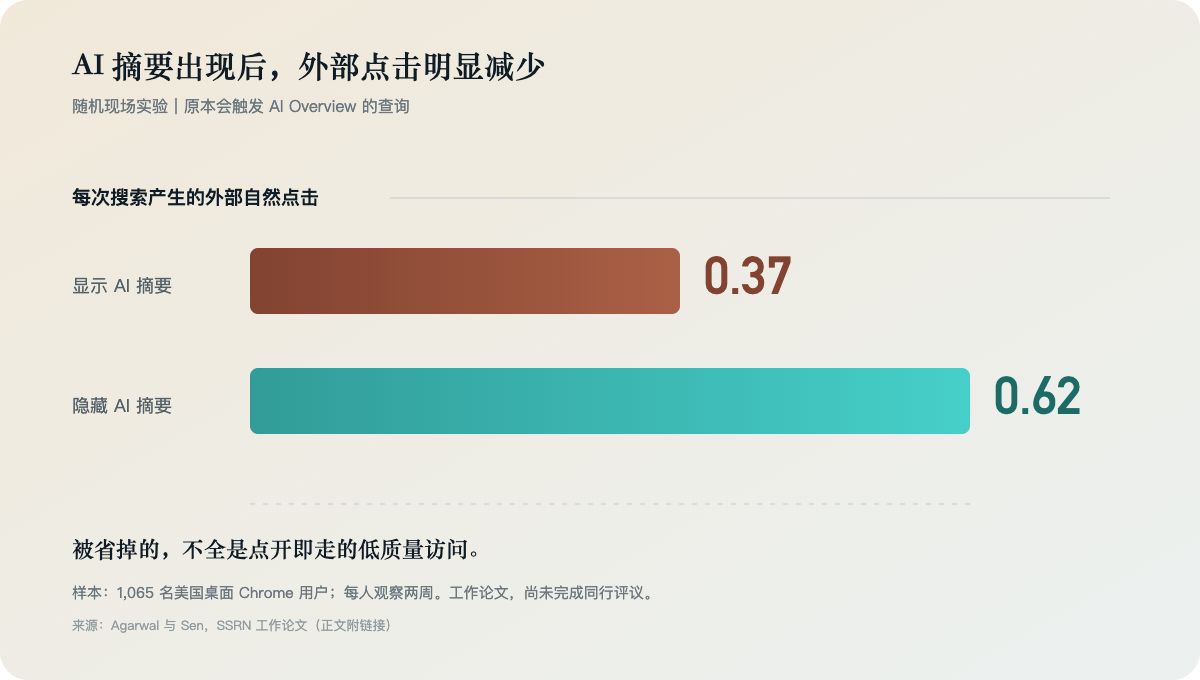
Figure | For the same type of query, external organic clicks were lower when an AI Overview was shown.
The change on the publisher side has been more severe. Chartbeat tracks billions of pageviews across thousands of news and media sites. From December 2024 to December 2025, pageviews referred by Google Search fell by 34%; large sites were down 22%, medium sites 47%, and small sites 60%. Over the same period, total pageviews across the Chartbeat network fell by only about 6%. These figures look more like a “redistribution of traffic” and do not prove that AI Overviews alone caused the entire decline. Chartbeat's 2026 study
Google's response is that the aggregate matters. In August 2025, Liz Reid, head of Google Search, said that total organic click volume from Search to websites was broadly stable year over year, while “quality clicks” had increased slightly. Google argues that AI generates more—and longer—queries; additional searches can offset a lower outbound click rate per query, while traffic is also shifting toward forums, videos, podcasts, and first-hand perspectives. Google's official account
This explanation is not unreasonable. If the number of searches rises, total clicks may hold up even as the share of searches leading outward falls. But growth among a small number of sites can likewise conceal declines across a large number of small and medium-sized websites. Google has not released the underlying data, absolute click counts, or the distribution across websites. Nor does this account separate ordinary Search, AI Overviews, and AI Mode, so outsiders cannot independently verify it.
What can be established for now is that generative summaries reduce the probability that any single query will send a user off the platform. More queries and a redistribution of traffic may temporarily support the aggregate total. That is more restrained than saying “traffic has collapsed,” but it offers little comfort to authors whose survival depends on search.
4. UK regulators first unbundle the choices
On June 3, 2026, the UK's Competition and Markets Authority formally imposed a Publisher Conduct Requirement on Google. The decision did not set prices for authors, and the CMA did not find that Google had infringed copyright. It addressed a narrower question: can publishers remain in ordinary Search while refusing to let their content be used to generate AI answers?
Under the previous arrangement, the two choices were difficult to separate in practice. Websites needed to allow Googlebot to crawl them to enter the most important search distribution channel. The same search content could then be used to ground answers generated in real time by AI Overviews and AI Mode, and might also enter generative AI services outside Search. If refusing the crawl meant disappearing from ordinary Search, the supposed option to leave carried little bargaining value.
The CMA requires Google to provide three sets of safeguards: publishers must be able to exercise separate controls over whether their content is used in generative AI; they must receive separate engagement data, and Google must take reasonable steps to attribute their content clearly and accurately; and opting out of generative AI use must not result in demotion or other adverse treatment in ordinary Search. The controls cover training, including fine-tuning, and retrieval-augmented generation, or “grounding.” Grounding within Search must also support directory-level and page-level opt-outs. CMA decision page
The decision has been made, but implementation is still under way. Most obligations take effect on December 3, 2026, while page-level grounding controls take effect on March 3, 2027. Google has begun giving a subset of UK websites access to a new Search Console toggle, but this remains a limited test. Websites can opt out of the generative features in AI Overviews, AI Mode, and Discover while retaining eligibility for ordinary Search. Google's help documentation also makes clear that the toggle does not currently govern model training; limiting training still requires Google-Extended. This is the start of implementation, not yet the delivery of everything the CMA requires. Google's test announcement and Search Console Help
The CMA recorded and addressed a related concern in its final decision: control may not produce fair compensation. Because AI Overviews occupy the most prominent part of the results page, publishers may be afraid to opt out even when they have the formal right to do so, for fear of losing exposure. The CMA will continue to monitor whether publishers can secure fair remuneration and may examine further measures on the exchange of value if needed.
For now, regulation has added choice and transparency. Publishers can refuse and can see the loss. Who bears the cost of producing the content remains unresolved.
5. Neither attribution nor GEO can pay an author's bills
Attribution is useful. It simply is not a return in itself.
On the same AI answer page, being cited is of course better than not being cited. Source labels tell users where an answer came from and can help specialist authors build a brand. The occasional user who clicks through may have stronger intent. But attribution does not automatically create visits, transactions, or lasting relationships, and it does not answer how much the platform should pay for the content.
Attribution, access, and compensation are three different questions.
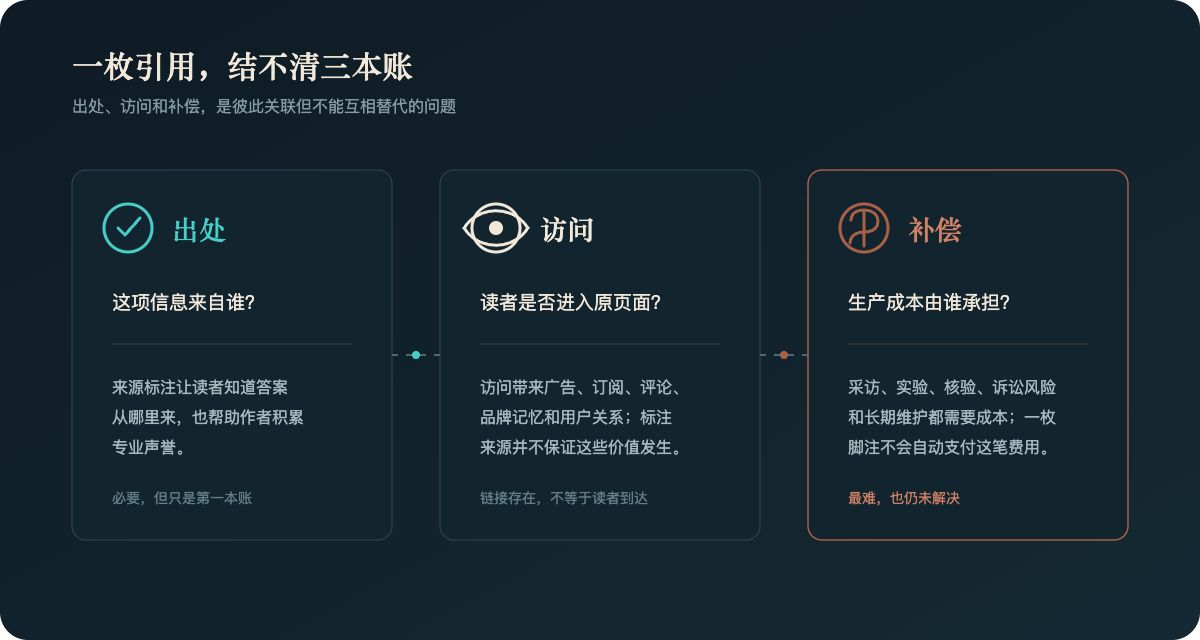
Figure | Source attribution matters, but it cannot replace access, much less automatically create compensation.
Attribution answers, “Who did this information come from?” Access determines whether the user actually reaches the original page. Compensation addresses who pays the cost of investigation, research, and professional writing. A clear footnote may encourage a visit, but it cannot guarantee one, much less substitute for compensation.
If the platform treats “the source was cited” as a settled transaction, the author receives a credit while the user has already consumed the work inside the platform. The accounts do not balance.
As traffic fell, GEO—generative engine optimization—quickly became a business: making content more likely to appear in AI answers, receive citations, and secure a more prominent position. A 2024 KDD paper found that, in generative engines built by the researchers, some optimization methods increased what the paper defined as “source visibility” by roughly 30% to 40%. But the metric measured a source's position, share, and influence in generated answers—not clicks, subscriptions, or revenue. Original GEO paper
Google's official guidance, updated in July 2026, likewise warns that AEO/GEO tactics cannot replace basic SEO and genuinely distinctive content; mechanical “chunking,” llms.txt, and inauthentic mentions are not shortcuts. Google's guide to optimizing for generative search
GEO can help an individual author compete for a citation, but it cannot repair the content ecosystem as a whole. It changes who gets extracted and who receives credit; it does not answer how a platform should return value after the extraction. Once everyone learns GEO, the competition simply begins again within the answer page.
6. Will authors leave the open web?
Some content will retreat into subscriptions, newsletters, membership programs, and closed communities, establishing a direct relationship first and only then deciding how much to make public. Other content will move from “an article that can be summarized” to something a user must actually enter and use: live databases, calculators, filters, templates, complete evidence archives, continuously updated projects, and transaction points. Personal brands, audio and video, and communities will also matter more, because readers are looking not only for a conclusion but for a specific person and an ongoing relationship.
No kind of content can truly prevent AI from summarizing it. A primary investigation may be compressed into a single sentence; an original dataset may be reduced to a single number. What is more likely to retain value after the summary is a verifiable method, continuously updated data, a tool that must actually be used, or a relationship available only to members.
That is rational self-preservation for an individual author. It may not be good news for the open web.
In the past, putting the best content openly on a webpage allowed search traffic to recover at least some of its cost. If more high-quality content moves behind paywalls, into apps, and into private communities, the public web will be left with more low-cost compilations, corporate PR, and outdated material. AI will still be able to answer, but the supply of fresh, high-quality material it can read will grow thinner.
The efficiency generative search offers users is real. No one should have to open ten pages and assemble an answer just to preserve publishers' business models. But platforms cannot assume that the cost of producing content has disappeared simply because the user experience is more convenient.
The open web once settled part of the bill for content through traffic. Generative search is reducing that payment, without yet creating a new ledger.
Source attribution answers: Where did this sentence come from?
The harder question remains: next time, who will still be willing to spend three months establishing that sentence?