
As the tools get better and better, why does the workload keep growing?
Someone leaves the team, and the position stays vacant.
Managers rarely say plainly what is happening. What reaches you is usually a more tactful version: the tools are so capable now, so let’s absorb the work internally for the time being; AI can handle this, so the rest of the team can divide it up; if the workload really does increase, then we can consider whether to hire.
AI really does make the work faster. A document that once took two hours to produce can yield a respectable first draft in twenty minutes. But the hundred minutes saved are rarely returned to you in full. You make another version for the client, add a comparison table, work in a competitor analysis that would not previously have been done, and prepare a one-page summary for your manager. By the end of the day, you have produced more than before, but you do not feel any less tired.
Many people will recognise this scene. The real question was never whether AI is useful. It is why, now that AI has become so easy to use, workloads have not fallen with it.
Over the past few years, discussions of AI and employment have tended to rush towards one grand question: will machines replace people? But for most people still sitting at their desks, the more immediate change is not a dismissal email arriving out of the blue. It is something quieter: one person disappears from the team, the seat is never filled, and work once shared by several people begins to gather around those who remain.
AI did not create more work out of thin air. What it has changed is the calculation inside the company: how many people does it take to get all of this done?
1. First, the fair point: AI really does save time
We should begin by acknowledging a fact: AI is genuinely effective at some tasks.
A randomised field experiment involving 7,137 knowledge workers across 66 firms offers strong evidence. In the second half of the six-month experiment, employees who had access to generative AI and continued to use it spent about two fewer hours on email each week. They also spent less time handling email outside regular working hours. Tasks requiring coordination among several people, such as meetings, did not change to the same extent. But at least for work that can be completed alone, such as email, AI did save time. The research preprint was updated to its fourth version in November 2025.
A nationwide survey published by the Bank of Korea in 2026 reached a similar conclusion: using generative AI was associated with a 3.8% reduction in average working time, equivalent to about 1.5 hours a week. The Bank of Korea’s research note did not simply count all of this saved time as additional output. The accompanying paper even found that workers were more likely to convert it into a little leisure during the working day than into further production. Accompanying paper
So the idea that AI can give people room to breathe is not a myth. In some tasks and some organisations, it has genuinely happened.
That is precisely why the next question is so uncomfortable: if a task really can be completed faster, why have so many people’s working days not become shorter?
The answer is not hidden in model parameters. It lies in whose hands the saved time passes through.
2. Efficiency reaches the company ledger before it reaches your calendar
From the employee’s side, AI saves half an hour or an hour. Look across the table from the company’s side, however, and the same gain is converted into a very different set of numbers: how many people a team still needs, whether a vacant position is worth filling, and how many more projects the company can take on in a quarter.
American companies have been unusually direct about this calculation. In 2025, Amazon CEO Andy Jassy wrote in a public message to employees that as the company deployed generative AI at scale and gained efficiency from it, Amazon expected its total corporate workforce to shrink over the next few years. In the same message, he asked employees to think about how to get more done with “scrappier teams.” Amazon’s public message
This was not a ceremonial remark. It was an algorithm already embedded in business decisions: if fewer people can complete the same work, the efficiency gain first appears as a reduction in headcount, rather than a shorter working day.
Layoff statistics are beginning to speak the same language. According to the American outplacement firm Challenger, U.S. employers cited AI in connection with 101,743 announced job cuts in the first half of 2026, about 23% of all planned cuts during the period. This figure records the reasons employers themselves gave. It cannot establish that AI independently caused every one of those cuts; industry cycles, cost pressures and business restructuring may all have played a part. But it is enough to show one thing: using AI as a reason to recalculate how many people are needed is no longer hypothetical. Challenger’s June 2026 report
In China, this calculation is usually called “workforce efficiency”
Compared with Amazon’s direct declaration, Chinese companies tend to prefer phrases such as “improving organisational efficiency” or “raising workforce efficiency.” Inside an actual team, this usually becomes something simpler: when one person leaves, do not replace them for now.
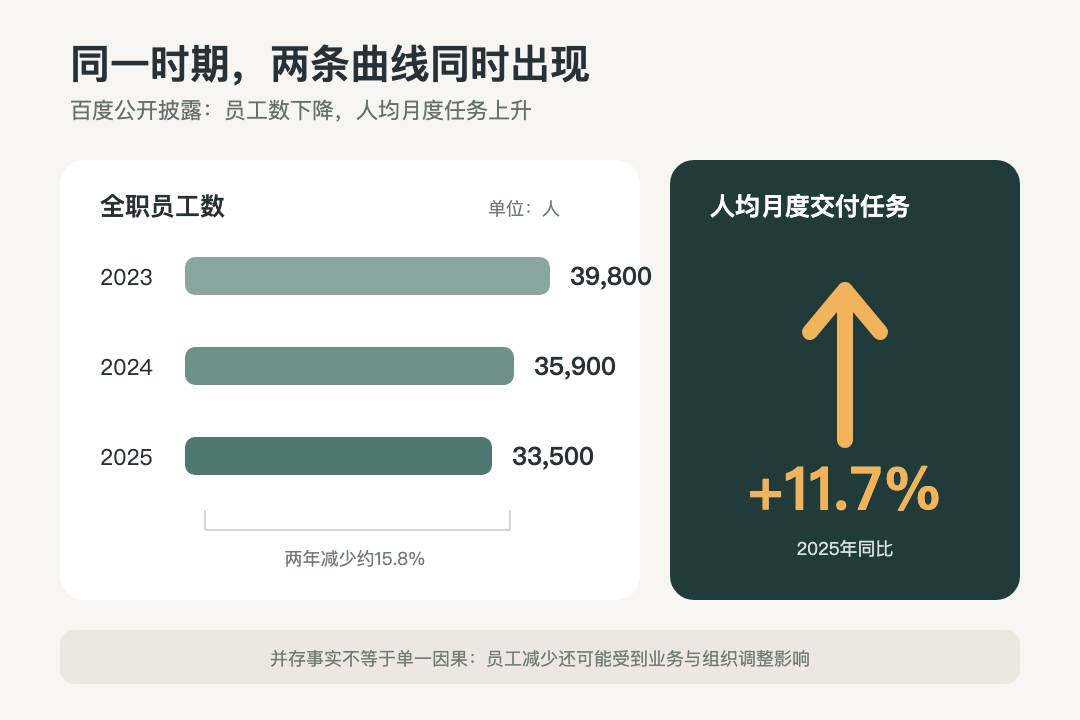
Baidu is a case worth examining closely. The company disclosed that its number of full-time employees fell from about 39,800 at the end of 2023 to about 35,900 at the end of 2024, and then to about 33,500 at the end of 2025. Baidu’s 2024 annual report, Baidu’s 2025 investor information
Over the same period, Baidu’s 2025 ESG report disclosed another curve: its in-house coding assistant helped increase the average number of tasks delivered per employee per month by 11.7% year on year. Of the 165.5 million lines of code delivered during the year, 56.6% were generated by AI. Baidu’s 2025 ESG report
One curve points down and the other up. They can only be placed side by side; they cannot be welded into a causal claim. The fall in employee numbers could equally have resulted from business contraction or organisational restructuring. It cannot prove that AI replaced every position that disappeared. What the public materials do support is a narrower conclusion: AI is becoming part of how companies measure output per employee. The question is no longer only, “Can you complete the work?” It is now followed by another: “With AI, how much should one person be able to complete?”
Nor have all of China’s internet giants been reducing headcount. Tencent’s employee count rose from 110,558 to 115,849 in 2025. Tencent’s 2025 annual report A company can use AI to expand its business and create new demand while hiring more people at the same time. This shows that technology has not written a single script for every company. What determines workers’ circumstances is whether a company chooses to turn efficiency into growth, profit, fewer people, or shorter working hours.
Among small and medium-sized enterprises, the change is less likely to appear in a formal layoff announcement. A survey by the China Academy of Information and Communications Technology covering more than 1,300 specialised and innovative SMEs found that AI had already entered equipment management, intelligent sorting, supply-chain optimisation and visual quality inspection, although most firms were still using it only in relatively simple applications. The report also describes a broader digital transformation project in an industrial cluster where average production efficiency rose by 25% and the number of managers fell by 30%. This was a broader digital transformation, not a result that can be attributed to generative AI alone, and it cannot show that every SME will follow the same path. But it does illustrate one way efficiency can be realised: first in the staffing plan, rather than in the time people leave work. CAICT, *Research Report on the Digital Transformation of Specialised and Innovative SMEs (2024)*
3. The position is gone; the work is not
One fewer person does not mean a proportional reduction in tasks. Most of the time, the only thing that changes is who must now do them.
In the past, a report might have had only one version because producing three more was not worth the cost. AI makes the cost of “one more version” very low: one tailored to the client’s preferences, another adapted to the manager’s habits, a one-page summary, and then a table translating the conclusions. Work that would never have been commissioned before now enters the to-do list one item after another because it can supposedly be done “while you are at it.”
This is why total workloads can continue to expand even after individual tasks become more efficient. Employees have not suddenly developed a love of extra work. In an organisation without clear task boundaries, once the cost of doing one more thing becomes low enough, “there is no need” quickly turns into “why not?”
More tasks are only the first layer. The second change occurs at the threshold for what counts as finished.
Perhaps it once took two days to review a contract, while AI can now produce a framework in half a day. Soon, half a day is no longer an efficiency worth praising; it becomes the new deadline. Perhaps submitting the main document was once enough. Now, a summary, risk table, revision note and external email are expected as standard. The time saved has not really vanished. It has been rewritten into a new standard: faster, more detailed and more personalised.
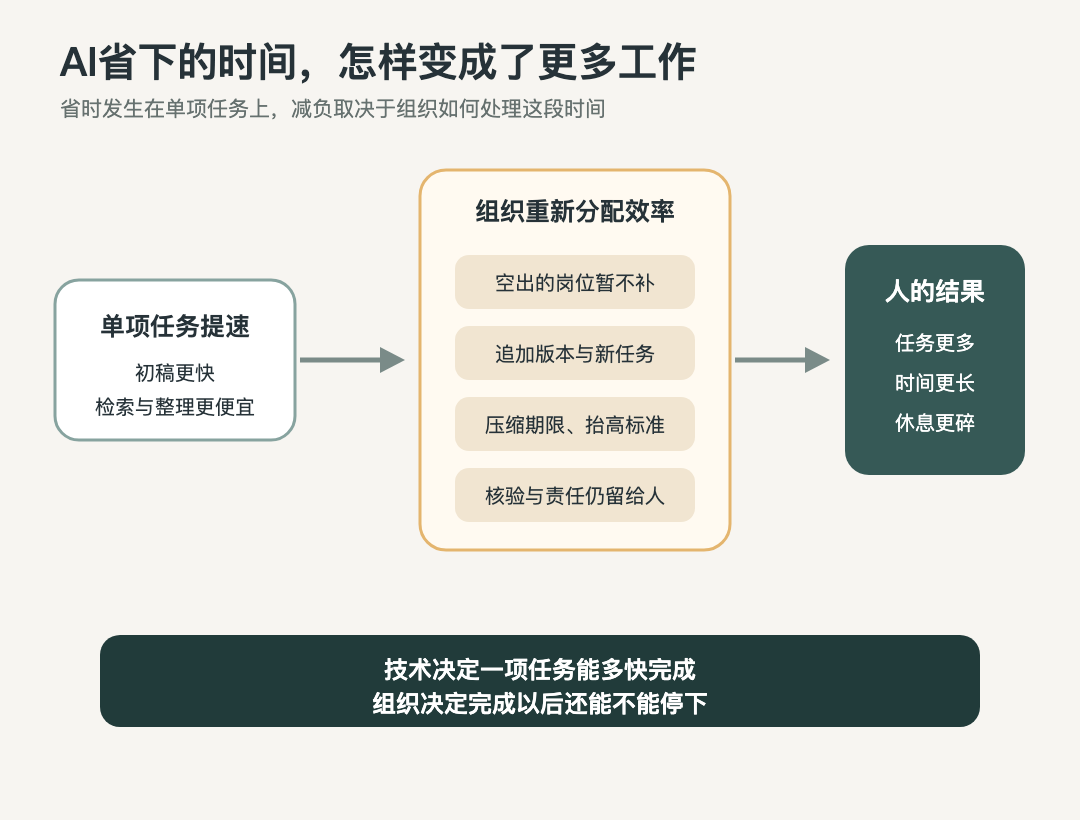
This shift is difficult to capture fully in working-time statistics. A person’s burden can grow in at least three ways: the working day becomes longer, more tasks are packed into each hour, or the day is fragmented by parallel assignments and a stream of notifications. The fact that the clock says you leave at the same time does not mean the intensity has stayed the same. More work does not always translate immediately into longer recorded hours.
Chinese workplaces already have little spare capacity to absorb this additional pressure. According to the National Bureau of Statistics, employees of enterprises nationwide worked an average of 48.2 hours a week in May 2026. National Bureau of Statistics data This indicator is not defined on the same basis as the statutory standard working-time regime, so every hour above 40 cannot simply be counted as unlawful overtime. It supports a narrower point: AI is not entering a workplace that is well rested and governed by clear boundaries.
Against this background, efficiency tools are most readily used to demand more output. The half-hour an employee saves sounds too trivial to matter. It is not long enough for a proper break, but it is just enough to fit in another task.
4. First drafts have become cheaper; verification has not
For lawyers, programmers, accountants and other professionals who remain responsible for the outcome, AI has produced another easily overlooked transfer: less work goes into generating, while more goes into verification.
AI can quickly produce a neatly structured contract review, but it will not confirm for the lawyer whether the cited provisions remain in force. It will not choose the legal basis for the client’s claim, and it will not assume professional responsibility if an amount is calculated incorrectly. The more a machine-generated text resembles the right answer, the more the person reviewing it needs to know where an error may be hiding in an apparently flawless passage.
Trial guidance on lawyers’ use of AI tools in community legal advisory services, issued by the Shanghai Bar Association in 2025, describes this “last mile” in concrete terms. Laws and cases generated by AI must be checked for authenticity, accuracy and currency. Limitation periods for litigation and arbitration, as well as monetary calculations in generated documents, must be reviewed item by item by a lawyer. Before materials are uploaded to a tool that is not deployed locally, privacy, personal information and trade secrets must also be properly protected. Shanghai Bar Association trial guidance
This work no longer attracts attention in the way that confronting a blank page does. It is fragmented and dispersed, often dismissed with the phrase, “Just take a quick look.” Yet whether a professional work product can be signed off and delivered ultimately depends on whether these inconspicuous steps have been completed properly.
AI has made the first draft cheaper. It has not made the signature cheaper.
It also creates an optical illusion. When a document can be generated in twenty minutes, an observer can easily mistake those twenty minutes for the whole of the work. Verification, deletion, revision, judgment and responsibility are all hidden behind the machine’s fluent output. The employee must both guarantee a faster delivery and absorb an offhand remark: “Isn’t this just something AI does in a click?”
The more technology replaces visible actions, the more the remaining human labour is pushed into corners that are difficult to measure but cannot tolerate mistakes. The work has not disappeared. It has moved from “writing it yourself” to “watching, judging and taking responsibility.”
5. Why faster does not mean leaving earlier
An NBER study using American time-diary data from 2004 to 2023 found that, after the ChatGPT shock, higher occupational exposure to AI was associated with longer working hours and less leisure. It also found that the relationship was stronger where workers had less bargaining power and where monitoring and performance were easier to observe. NBER working paper, “AI and the Extended Workday”
The study measures AI exposure at the occupational level rather than tracking each individual, so it cannot simply be translated into the claim that “using AI makes everyone work several more hours.” What it points to is a problem of distribution: when AI and human work complement each other, productivity gains do not automatically flow back to workers. Companies can convert them into higher targets, and consumers can receive them as faster responses. What workers may receive is simply a more crowded task list.
This is the hidden conveyor belt behind the experience that the tools keep getting better while the work keeps growing: AI makes one task faster; the organisation decides where the saved time goes next.
A position is vacated and never filled. “Faster” is then raised into the new passing grade. The responsibility for verification and mistakes remains entirely with the person. When all three happen at once, the time AI saves is more likely to be reassigned before it ever reaches you.
You have not become slower. “Faster” has been written into the company’s new starting point.
What people experience, then, is not simply “more overtime.” Sometimes the working day really does become longer. Sometimes the clock barely moves, but more tasks are packed into the same span of time. At other times, work seeps into lunch, the commute and the fragments before sleep that once belonged to the individual. These three forms can appear separately, or arrive together.
And so the paradox holds: the company gains higher workforce efficiency, the client gets a faster reply, and the machine produces more first drafts, but the people who remain do not get to go home any earlier.
6. Who owns the time that AI saves?
The Bank of Korea study and the Copilot field experiment remind us that another outcome is equally possible. AI users can spend less time on email, do less work outside regular hours, and convert part of the efficiency gain into genuine leisure of their own.
This does not contradict the observations in this article. These counterexamples show that becoming busier is not a technological destiny. Whether technology reduces a person’s burden depends on whether workers have the power to keep the time they save, and whether the organisation responds by adding tasks, raising standards or cutting staff.
The questions we should really ask are therefore more specific. When one person leaves, will the position be filled? When work becomes faster, who determines the limit on tasks and the standard for delivery? When the machine generates and the human signs, how should the time and responsibility required for verification be counted?
AI can shorten the time required for some tasks. Whether that time becomes an earlier finish or the next assignment is not for the model to decide.
Saving time is a technical result. Reducing the burden is a distributional result.
If one person leaves your team, is one person hired to replace them, or is their work divided among everyone who remains?